







Mouse Shell Coatings Explained: What They Actually Do (and Why More Isn’t Always Better)
Many people think a “fancier” coating automatically means a better gaming mouse. In reality, different coatings solve different problems. Some exist mainly to hide manufacturing flaws rather than improve feel.
This article walks through the major coating types you’ll see most often on current gaming mice, then covers a few others you’ll run into.
Why Coatings Exist in the First Place
Gaming mice are usually injection-molded from ABS, polycarbonate (PC), or carbon fiber composites. These parts often come out of the mold with visible marks — parting lines, gate marks, sink marks, and small surface inconsistencies.
One basic reason for coatings is to cover these flaws. A textured or matte finish hides imperfections that a glossy bare shell would show right away.
But coatings do more than hide problems. They change how the mouse feels and performs in your hand. The right coating can add friction for better control during fast movements, reduce slipping from sweat during long sessions, or give a texture that raw plastic can’t match. It’s real engineering.
Sometimes a coating improves grip and feel. Sometimes it mainly masks a lower-quality mold. Often it does both. A clean bare-mold shell without coating can feel better than a coated shell covering up poor surface quality underneath. A good coating on a solid shell adds real value.
EDM Texture (No Coating / Bare Shell)
What it is: The texture is cut directly into the mold using electrical discharge machining (EDM). It’s not a sprayed layer — the texture is part of the plastic from the moment the shell is molded.
Why people like it: It keeps the raw plastic feel. There’s no separate coating that can wear off or peel.
Trade-offs: The texture options are more limited than applied coatings, and once the mold is made, it’s hard to change. Some users prefer the wider range of feel that true coatings can provide.
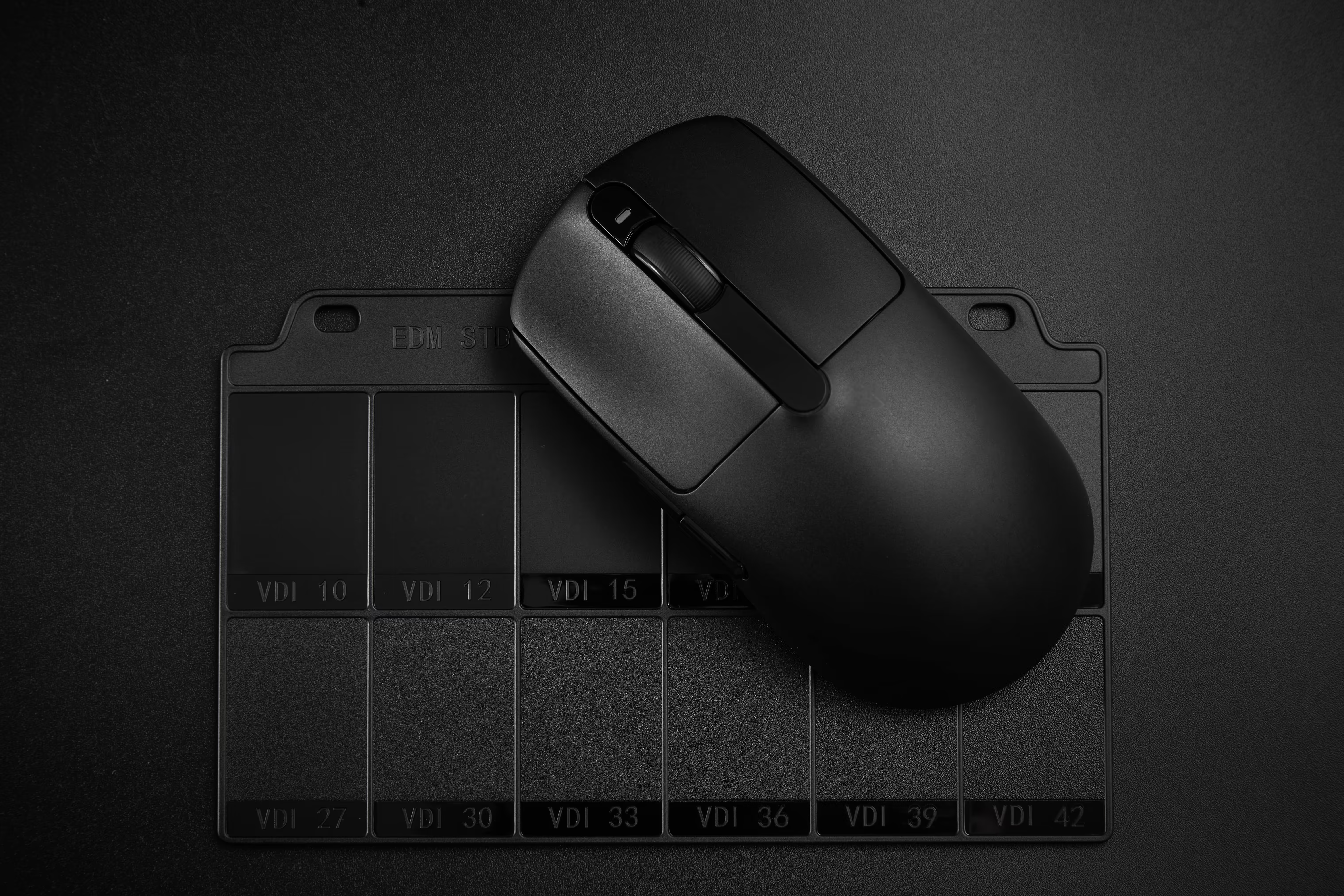
UV Coating: Two Different Tiers
UV coating as a category means any coating cured by UV light exposure — that part is broad and tells you almost nothing on its own. What actually matters is what’s in the formula before it’s cured. There are two distinct tiers:
Basic UV Coating
What it is: A straightforward cured clear coat — glossy or matte — with no nanoparticles added. Its job is protection and surface appearance, not engineered texture or hardness.
Why it’s used: It’s cost-effective and widely used at scale. You’ll find it on plenty of well-regarded mice — for example, this is the tier behind finishes like the matte coat on the Logitech G Pro X Superlight.
Trade-offs: It shows fingerprints more easily and tends to scratch and shine in high-contact spots over time, since there’s nothing in the formula reinforcing surface hardness.
Nano Coating (UV + Nano-SiO2)
What it is: This is what the industry actually means when it says “nano coating” — a UV coating formula with nanoscale particles mixed in, most commonly nano-SiO2, typically in the 3–5% range. The primary goal is hardness and scratch resistance (pencil hardness in the 4H–5H range), not texture. A controllable micro-roughness is a secondary benefit of the particle loading, not the main point.
Why it’s used: Better durability and scratch resistance than basic UV coating, at a moderate cost increase, with a touch of added grip/texture as a side benefit.
Trade-offs: Still a thinner, more conventional layer than excimer coating (below) — it doesn’t produce the same depth of engineered microtexture. Consistency depends on how evenly the nanoparticles disperse in the formula and cure.

Excimer Coating
What it is: A mechanically different process from either UV tier above — this isn’t about what’s mixed into the formula, it’s about how the coating is cured. It uses 172nm excimer UV light. Because this wavelength only penetrates the very top layer of the coating, the surface skins over and shrinks while the layer underneath is still liquid — this creates a controlled micro-wrinkle structure rather than a smooth film. The depth and density of the wrinkles can be tuned by adjusting curing energy, which gives this process fine, repeatable control over friction and roughness — a different mechanism than adding nano-SiO2 for hardness.
Best for: Carbon fiber composite or premium alloy shells where standard EDM texture isn’t practical. It gives finer, more tunable control than either UV tier above.
Trade-offs: The process and equipment are more specialized and costly than basic or nano UV coating. With heavy use over time, the micro-wrinkle texture can gradually wear smoother and develop shiny spots in high-contact areas, though the cured layer itself stays quite scratch-resistant. Because the wrinkle layer sits on top of the shell surface, it can also visually soften or partially obscure a fine pattern underneath — such as a woven carbon fiber weave.
Open question on color variants: On some shells, the visible carbon fiber weave is part of the design, and a heavier excimer wrinkle texture can mask it, which is reportedly why certain colorways (e.g., black models) use a UV tier instead of excimer. Whether that’s specifically the basic or nano-particle UV tier hasn’t been confirmed yet; worth nailing down before stating it definitively in a published version.


Other Coatings Worth Knowing
• Soft-touch / rubberized coating: Gives a matte rubbery feel that many like at first. The main problem is hydrolysis — the polymer breaks down with humidity, UV exposure, and skin oils, and the coating can turn sticky or tacky after months, especially in humid environments.
So Which Coating Is “Best”?
There isn’t one best coating. It depends on the shell material, your climate, hand sweat, your grip style, and how good the base mold is.
Choosing an EDM-finished bare-mold shell over a coated one isn’t automatically a downgrade — many experienced users prefer the direct material feel. And a basic or nano UV finish isn’t automatically a downgrade from excimer either — sometimes it’s the more deliberate choice, like preserving a visible carbon fiber weave.
When comparing mice, pay attention to texture consistency, whether it gets tacky after a few weeks, and how visible fingerprints are. And if you see “nano coating” mentioned in a spec sheet, it’s worth checking which of the two UV tiers it actually refers to — basic clear coat or particle-reinforced — since “nano” gets applied loosely in marketing.
If you want to adjust the feel later, grip tapes (mouse skin stickers) are a simple and effective option for many people.
That’s the practical takeaway: coatings are tools with specific jobs — not automatic upgrades. Test what actually works for your hand and play style.