







Why Do Many 8K Wireless Mice Need an Extender?
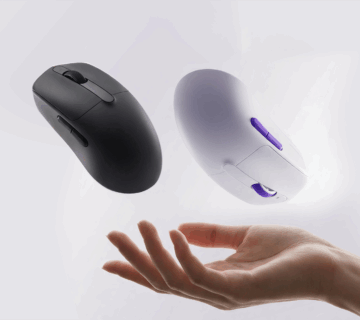
If you’ve used a high-polling-rate wireless mouse (4K or 8K), you’ve probably noticed an included accessory: a USB extender (or dongle dock).
At first glance, it looks like a simple cable that moves the receiver closer—but its real purpose is solving a fundamental wireless interference problem.
To understand why extenders exist—and why some mice don’t need them—we need to look at what happens between 2.4GHz wireless signals and USB 3.0.
The Root Cause: 2.4GHz vs. USB 3.0 Interference
Most wireless gaming mice operate in the 2.4GHz band.
Unfortunately, USB 3.0 and USB 3.2 ports generate electromagnetic noise in the same frequency range.
This is not theoretical—it’s a well-documented hardware behavior by the USB-IF organization:
- High-speed USB 3.0 data lanes emit broadband noise around 2.4GHz
- Rear motherboard USB ports are surrounded by:
- USB controllers
- GPU power circuits
- Wi-Fi and Bluetooth modules
- When a wireless receiver is plugged directly into these ports, it sits inside a noisy RF environment
The result:
Increased packet loss, unstable polling, and latency jitter.
At 1000Hz, this may be barely noticeable.
At 4000Hz or 8000Hz, the problem becomes obvious.
Why High Polling Rates Make the Problem Worse
An 8000Hz polling rate means:
- One report every 0.125 milliseconds
- 8× more data packets than a standard 1000Hz mouse
This puts extreme pressure on the wireless link:
- Any interference has less time to recover
- Packet retransmissions increase
- Weak RF designs quickly become unstable
That’s why many 8K wireless mice rely on an extender—not to boost performance, but to prevent signal degradation.
How to Install a Mouse Extender (Properly)
Using an extender correctly matters more than most people realize.
Here’s the proper way to install one for maximum stability. We take the example of Pulse 01 :
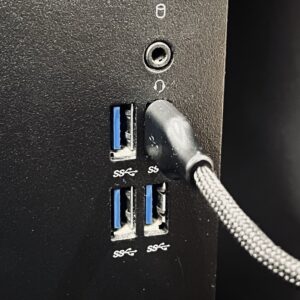
Step 1: Use a Direct USB Port
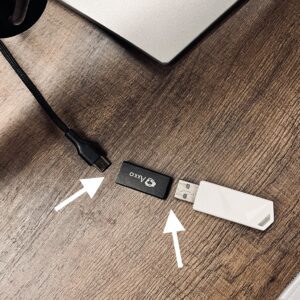
- Plug the extender cable directly into the PC, not through a USB hub
- Then connect the extender to the other end of the cable on the desk
Step 2: Place the Receiver Close to the Mouse
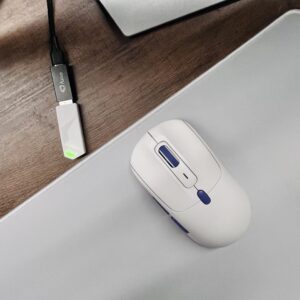
- Ideal distance: 20–40 cm from the mouse
- Keep it on the desk, not under or behind the PC
Step 3: Avoid Interference Sources
Keep the receiver away from:
- Wi-Fi routers
- External hard drives
- USB 3.0 cables
- Monitors with poor shielding
Step 4: Maintain Line of Sight
- Avoid placing the receiver behind metal objects
- Even small obstructions can impact high-frequency wireless signals
The extender works by physically removing the receiver from the USB 3.0 noise zone, not by amplifying the signal.
Do all 8K polling rate mice need an extender?
With a properly designed wireless system, an extender becomes optional.
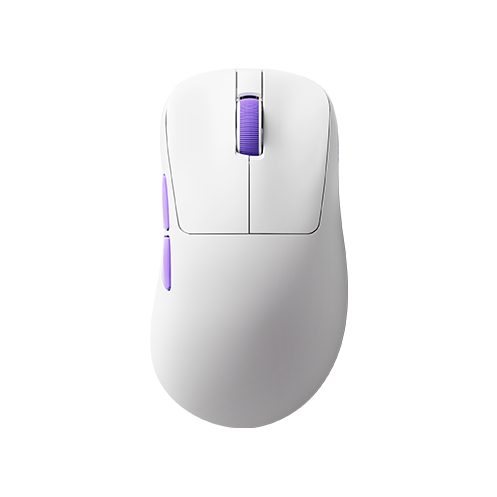
Wireless mice built on Nordic’s nRF52840 platform, for example, can maintain stable 8K polling rates even when the receiver is plugged directly into a USB port. For example, Akko’s nest gaming mouse demonstrated consistent 8K polling performance without the use of an extender under typical desktop environments without excessive wireless interference, as shown in this independent review.
Here’s why.
- Stronger RF Performance
- Higher-quality 2.4GHz radio front-end
- Better clock accuracy and modulation stability
- Higher tolerance to USB-induced noise
- MCU Power That Can Truly Sustain 8K
Running at 8000Hz isn’t just about transmission speed.
The MCU must handle:
- Sensor data intake
- Filtering and denoising
- Motion processing
- Packet assembly
- Wireless transmission
The nRF52840 has sufficient processing headroom and buffering to keep data flowing without congestion or timing drift.
- Mature Wireless Stack and Firmware
- Efficient retransmission logic
- Lower internal processing latency
- Stable performance even in electrically noisy environments
As a result:
Stable 8K polling can be achieved without relying on physical workarounds like extenders.
Conclusion: Extenders Are a Workaround, Not a Requirement
Whether a mouse needs an extender depends on:
- RF design quality
- MCU processing capability
- Overall wireless system architecture
When these fundamentals are strong, an extender becomes optional—not mandatory.
A wireless mouse that maintains stable 8K polling directly from a USB port represents a more advanced and mature wireless design, not just a higher spec number.